AI Trading Agents on Polymarket Crypto Markets: TWAP, Data and the GetBlock Stack
How an AI trading agent works on Polymarket short crypto markets: the GetBlock data, model and payment stack, and what TWAP settlement changes.

An AI trading agent is software that reads markets, decides and sends orders on its own. On Polymarket's short crypto markets it meets a specific rule: since August 2026 they settle on an average price, not a closing snapshot. Here is how such an agent is built on GetBlock infrastructure and what the rule changes.
GetBlock is a Web3 and AI infrastructure company founded in 2019 and incorporated in Singapore. According to its September 2026 media fact sheet, it serves more than 200,000 customers across 130+ blockchains and handles over 50 billion API requests a month. Its clients include Trust Wallet, MEXC and Tangem. For trading agents it brings chain data, live streams, a gateway to AI models and machine payments into one account.
Why short crypto markets attract agents
Polymarket lists up-or-down markets on bitcoin, ether and solana with five-minute, fifteen-minute and four-hour windows. Each one asks the same question about a price, again and again, around the clock. The wording never changes, the answer is a number and the clock is short. A political market needs someone to read a ruling. A five-minute bitcoin market needs fast arithmetic on a price, which is where machines are strongest.
Automated trading was already heavy in these markets, as covered in Polymarket bots. What is new in 2026 is the agent: a program that pairs fast rules with a language model and can choose its own tools, data and even pay for them.
How these markets settle now
Since 7 August 2026, short crypto markets on Polymarket resolve outside the UMA proposal and dispute process used elsewhere on the platform. The outcome comes from a time-weighted average price, or TWAP, computed by Chainlink at the end of the window. For five- and fifteen-minute markets the average covers the final 60 seconds. Five-minute markets used a 30-second average for their first week and moved to 60 seconds on 14 August, according to Polymarket's developer announcements and Genfinity's coverage of 12 August 2026.
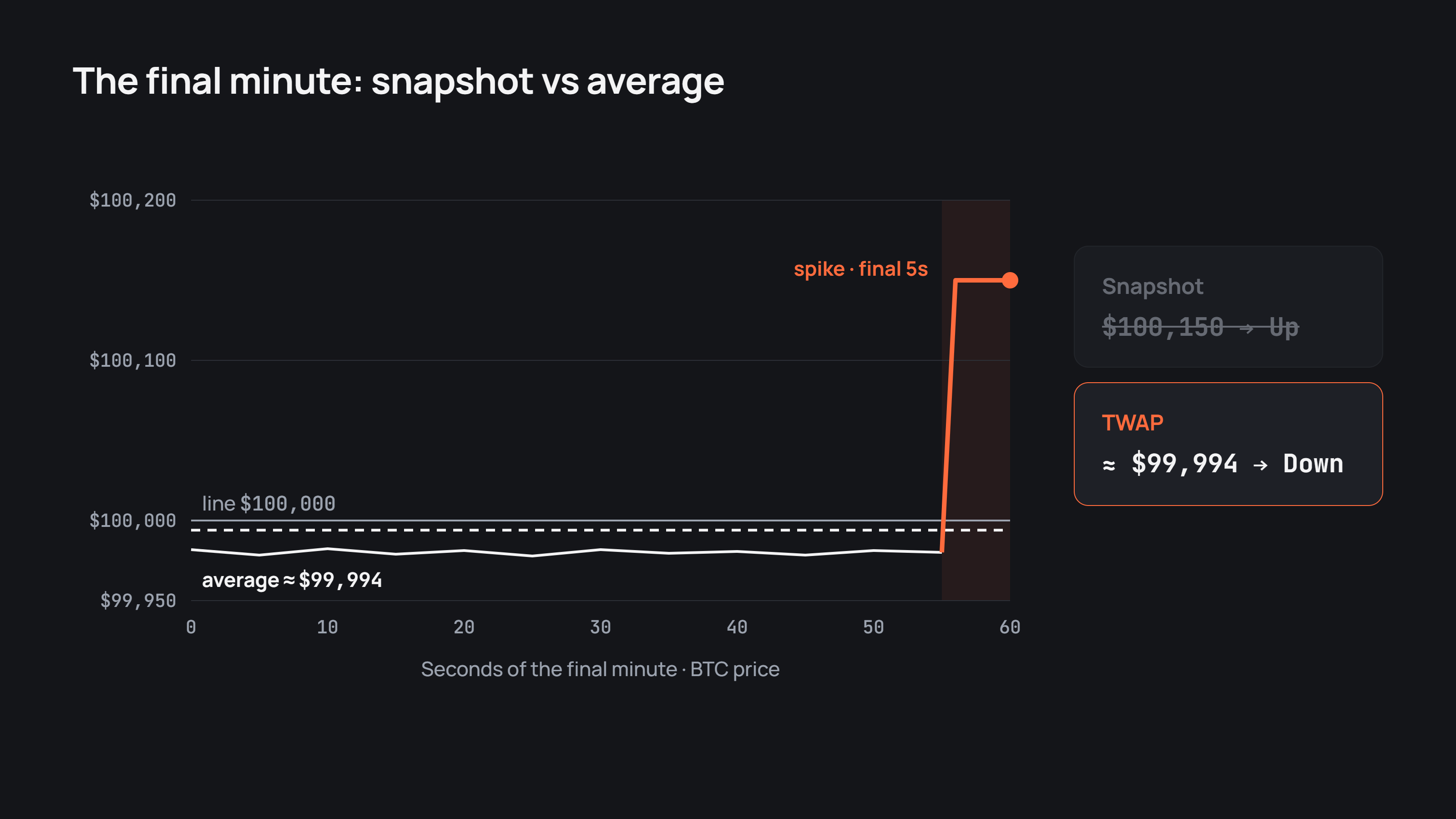
The difference from a snapshot is easiest to see in numbers. Say the line is $100,000. Bitcoin sits at $99,980 for 55 seconds of the final minute, then jumps to $100,150 for the last five. A closing snapshot would read $100,150 and settle Up. The average is (99,980 × 55 + 100,150 × 5) ÷ 60, about $99,994, and the market settles Down.
What TWAP changes for an agent
Under a snapshot rule, the only moment that matters is the last one. Under an average, every second of the final minute carries equal weight, and that turns the window into something an agent can track as it forms.
The average locks in as the window runs. Halfway through the final minute, half of the result is already fixed. Each later second can move the outcome less than the one before it. An agent that knows how much of the average is settled can tell when a market is effectively decided and when it is still open.
The last second loses its power. A single large trade on a thin exchange no longer flips the result. Strategies built around final-second moves stopped working in August.
The data source matters. Chainlink aggregates prices from many venues. An agent that watches one exchange can see a price that differs from the one used for settlement. The closer its feed is to an aggregated price, the closer its estimate of the average will be to the real one.
The four parts of a trading agent
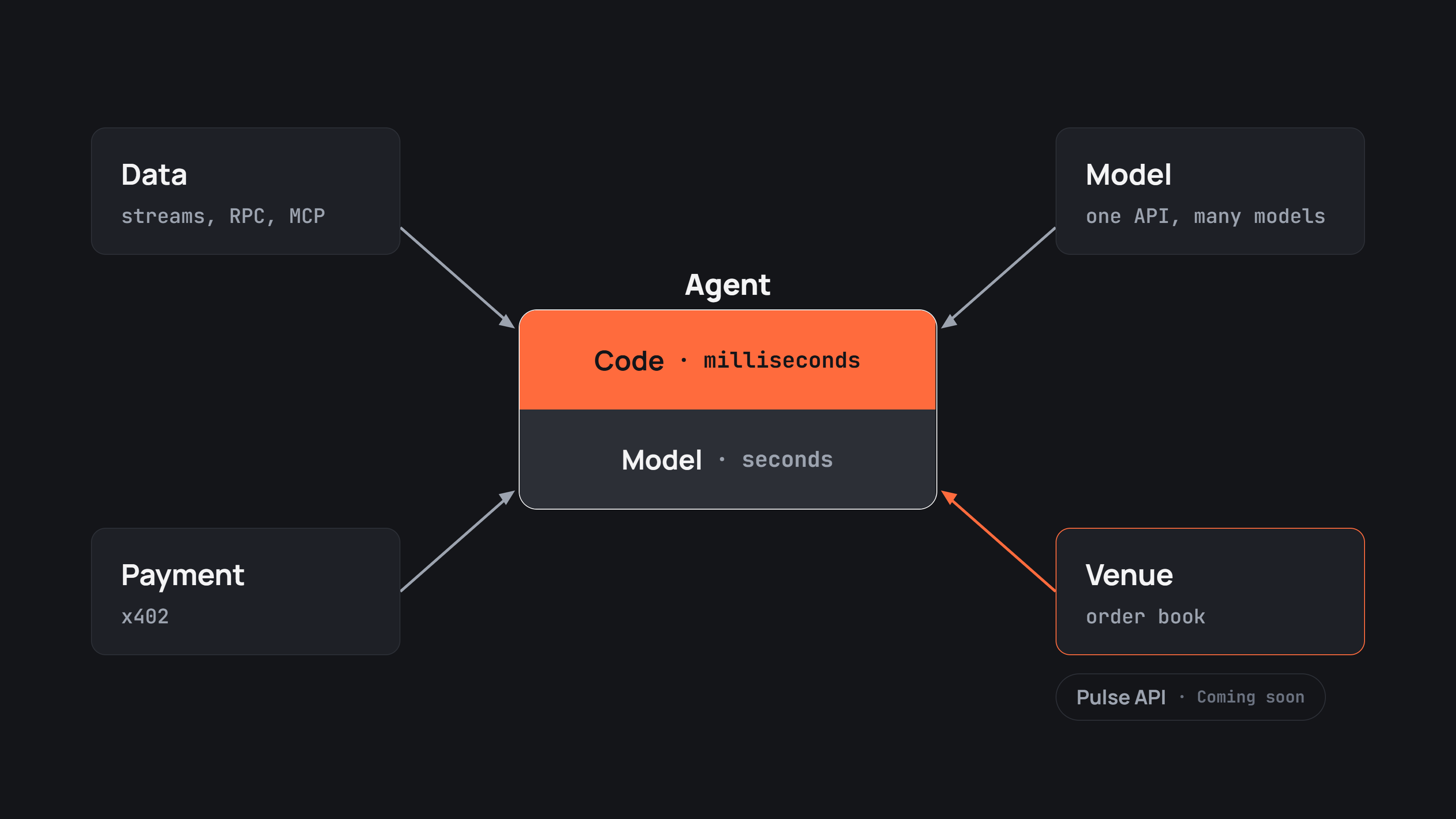
Every trading agent, simple or sophisticated, needs data, a model, a way to pay and a venue. GetBlock offers tools for the first three in one account, and in June 2026 it passed a SOC 2 Type II audit, the security check banks and payment firms ask for before connecting.
Data. The agent needs the underlying price as it moves and the chain data around its account. GetBlock's market data product streams normalized trades from DEXs and prediction markets, with topics for OHLCV candles, VWAP and TWAP, over WebSocket or HTTP. For chain data it runs RPC nodes, including Polygon nodes where Polymarket settles trades, and since June 2025 an open-source MCP server, the standard way for assistants such as Claude or Cursor to call outside tools.
A model. GetBlock AI routes requests to frontier and open-weight models through one OpenAI-compatible API, with spending and request logs in one place. A fast, cheap model can handle routine checks and a stronger one the harder decisions.
Payment. GetBlock supports x402, a protocol that lets software pay for an API call per request in stablecoins. An agent can buy the data it needs on the spot instead of relying on a subscription set up by a person.
A venue. The fourth part is the market itself: Polymarket's order book, reached through an interface with trading credentials.
Where the model sits and where the rules sit
A language model takes from under a second to several seconds to answer. In a five-minute market, that is a long time. Practical agents split the work.
Fixed code does the fast part: reading the book, updating the running average, placing and cancelling orders within milliseconds. The model handles the slower decisions: which markets to trade today, how to adjust parameters after a losing session, when conditions look unusual enough to stop. In short crypto markets the model acts as a supervisor, while the code does the trading.
That split also shows where agents struggle: a model can be confidently wrong about a market it barely understands, and code keeps quoting stale prices when its feed stalls.
What a person still sees first
Agents are strongest when tomorrow looks like yesterday, and short crypto markets are not always like that.
Scheduled news. A US inflation print or a Federal Reserve decision can land inside a fifteen-minute window. A person with a calendar knows it is coming. An agent sees it only when the price starts moving.
Venue trouble. When a large exchange pauses withdrawals or trading, prices across venues can split apart. The aggregated price used for settlement and the price an agent watches may drift away from each other for minutes.
In these moments the price in the book reflects less of what is happening, whoever the trader is: a person or a program.
What fees mean for an agent
Crypto carries the highest taker fee on Polymarket: $1.75 per 100 shares at 50¢, according to Polymarket's fee documentation and the rates in force since July 2026, falling toward the edges of the price range. Makers pay nothing and receive 20% of collected crypto fees back as a daily rebate. The full schedule is in Polymarket fees.
For an agent trading dozens of short windows a day, this decides the design. One that takes liquidity near even odds pays the most on every trade. One that rests limit orders in the book pays no fee and can earn a rebate, but it has to accept that its orders may not fill. How resting orders and depth show up in the book is covered in how to read an order book.
How to start with GetBlock
GetBlock has a free tier with shared endpoints across its supported networks, and no card is needed at sign-up. A working endpoint is live about 30 seconds after registration, according to the company. For an agent on prediction markets, three first steps cover most of the groundwork. Where each layer sits under a trade is covered in GetBlock and prediction markets.
A Polygon endpoint. It lets your code read balances, positions and settled trades of a trading account directly from the chain.
A data stream. Real-time streams push blocks, transactions and events to your application, so the agent reacts without polling.
The MCP server. Connected to Claude or Cursor, it lets you ask chain questions in plain language while you design the agent, before a line of trading code exists.
Paid plans with a fixed request rate or dedicated nodes are listed on the pricing page. The sign-up takes an email.
Why Pulse Market recommends GetBlock
A trading agent is only as good as the data under it and the speed at which that data arrives. GetBlock covers what sits below the market, and the Pulse terminal shows the market itself: the book, the spread, the price as a probability and your own results. If you are building toward automated trading while API access in Pulse is on the roadmap, GetBlock is a practical place to start the infrastructure side.


