Polymarket Fees: Who Pays, How Much and When
Prediction market fees on Polymarket in 2026: takers pay by category, makers pay nothing and earn rebates, and the fee peaks at 50¢. What each trade costs.

Polymarket charges a trading fee only to takers, the side that fills against an order already in the book. Makers pay nothing and get part of the fees back. The rate depends on the category, from zero in geopolitics to the highest in crypto, and the fee is largest when a share trades near 50¢.
Who pays: takers and makers
Every trade has two sides. The maker placed an order earlier, and it was resting in the order book. The taker arrived later and filled against it.
A market order is always a taker order, because it fills at once against what is already there. A limit order can be either. If your price crosses the book and fills on arrival, you are the taker. If it rests in the book and waits for someone else, you are the maker.
Through 2025 most Polymarket markets were free to trade. On 30 March 2026 fees spread to almost every category, on a model where takers pay and makers do not. The reason is liquidity: the fee paid by the side that removes liquidity funds rewards for the side that provides it, which keeps books deeper and spreads tighter.
Fees by category
The rate is set per category. The table shows the taker fee for 100 shares at 50¢, the price where it is highest. The figures follow Polymarket's fee schedule as of September 2026.
Category | Taker fee per 100 shares at 50¢ | Maker rebate |
|---|---|---|
Geopolitics | $0.00 | 0 % |
Politics, finance, tech, mentions | $1.00 | 25 % |
Sports | $1.25 | 15 % |
Economics, culture, weather, other | $1.25 | 25 % |
Crypto | $1.75 | 20 % |
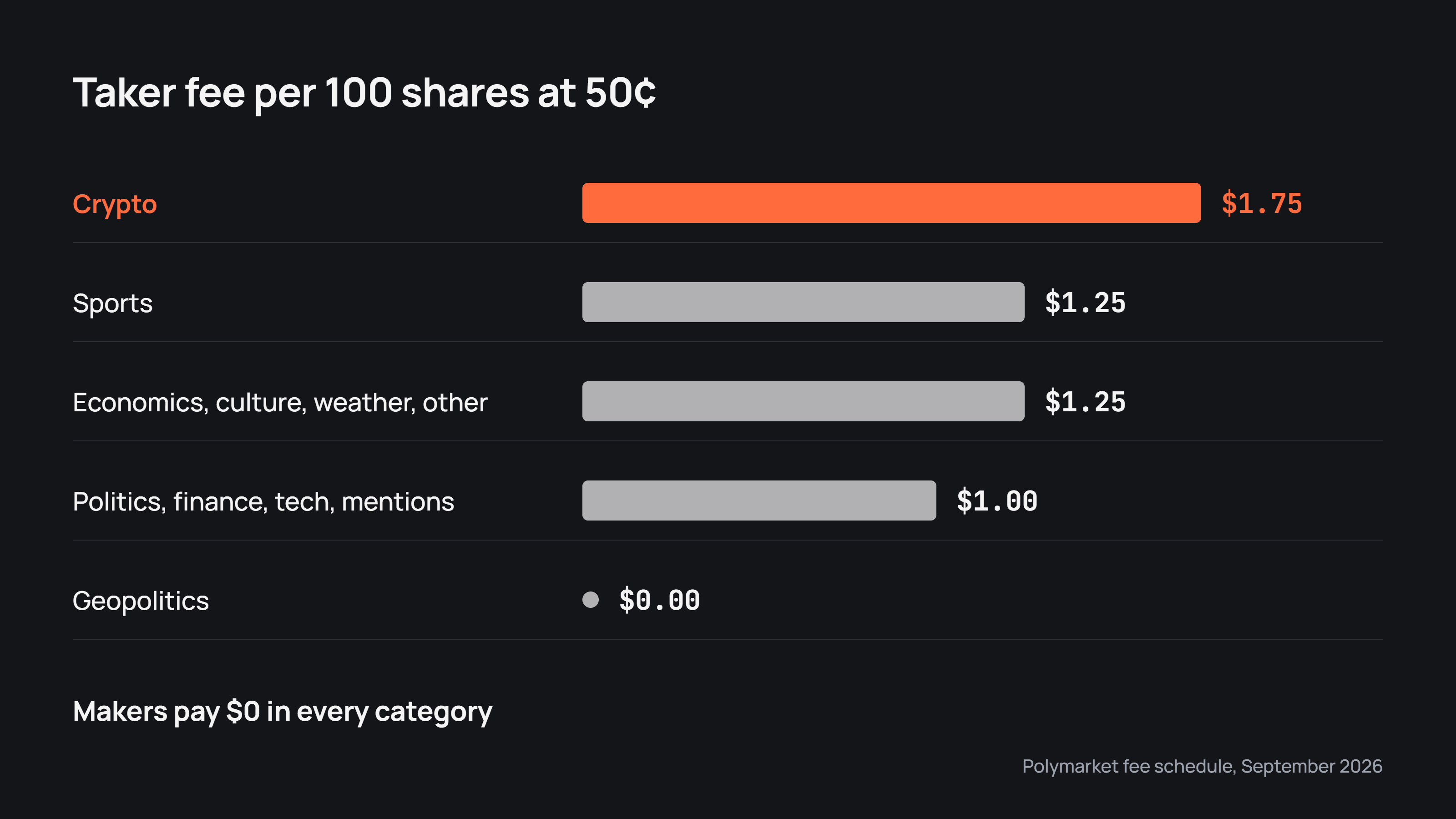
Sports changed most recently. In July 2026 its rate went from 0.03 to 0.05, and its maker rebate fell from 25 % to 15 %. Before that change sports was the cheapest category that carried a fee. It now sits alongside economics and culture.
Why the fee peaks at 50¢
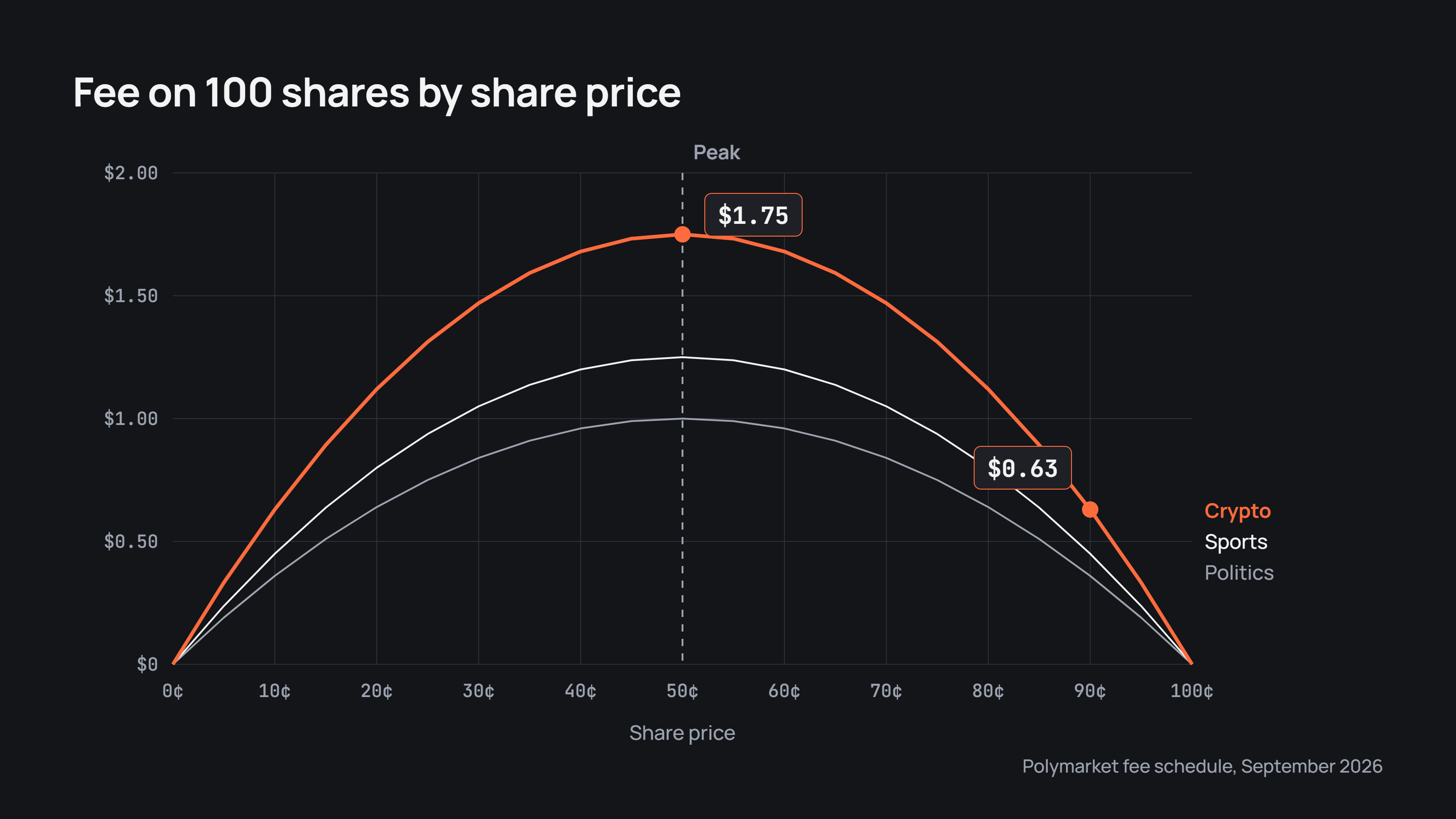
The fee is not a flat percentage of what you spend. Polymarket calculates it as the number of shares, times the category rate, times the price, times one minus the price.
The last two terms carry the shape. At 50¢ their product is 0.25, its largest value. At 90¢ or at 10¢ it falls to 0.09. Near either end it approaches zero.
Take 100 shares of a crypto market, where the rate is 0.07. At 50¢ the taker pays 100 × 0.07 × 0.5 × 0.5, which is $1.75. At 90¢ the same 100 shares cost 100 × 0.07 × 0.9 × 0.1, about $0.63 in fees.
The fee follows uncertainty. Markets where both sides trade near even carry the highest cost per share, and the cost falls as the market moves toward a clear favourite. This matters most for frequent trading around 50¢, where the fee comes on top of the spread at every entry and exit.
What makers get back
Makers pay no fee in any category. On top of that, part of the taker fees collected in each market goes back to the makers who provided liquidity there.
The share returned is 25 % in most categories, 20 % in crypto and 15 % in sports. Rebates are paid daily and split by each maker's portion of the liquidity that was traded in that market. A maker competes only with other makers in the same market, not across the whole platform.
Takers have a return of their own. Polymarket runs a tiered taker rebate program that gives part of the fee back to active takers.
No fee on winnings
The trading fee applies when you buy or sell. Settlement is separate. When a market resolves, each winning share pays $1.00 in full, and no fee is taken from the profit.
So a position held to settlement pays the taker fee once, on entry. A position closed early with a market order pays it twice, once in and once out.
Which markets carry fees
Fees apply to markets created on or after the date a category's fees were switched on. Older markets in the same category can still trade without them. The market page and the trade panel show whether a fee applies before you confirm.
How the fees arrived: 2025 to 2026
The current schedule came in stages, and older guides often describe one of the earlier stages.
When | What changed |
|---|---|
July 2026 | Sports rate raised from 0.03 to 0.05, sports maker rebate cut from 25 % to 15 % |
30 March 2026 | Fees extended to almost every category, maker rebates launched, geopolitics left free |
Mid 2025 | First fees on sports markets |
Early 2025 | First taker fees, on 15-minute crypto markets |
If a guide says Polymarket charges no trading fees, it predates March 2026. If it quotes a lower sports rate, it predates July.
How to pay less without trading differently
A few habits lower the fee without changing which markets you trade or what you think about them.
Rest your orders when you can wait. A limit order that sits in the book pays nothing and can earn a rebate. It suits entries you plan in advance, not moments when the price is running away.
Count the round trip. Closing early with a market order doubles the fee. If you expect to hold to settlement anyway, one taker fee is the whole cost.
Mind the category. The same trade costs less in politics than in crypto, and nothing in geopolitics. The rate is fixed per category, so it belongs in your cost check before the first order.
Watch the middle of the range. Around 50¢ the fee and the spread are both at their heaviest. Frequent trading in and out of even markets is where fees add up fastest.
None of this is a reason to pick a market. The fee is a cost to weigh against the gap between your estimate and the price, not a signal in itself.
Two different charges: the trading fee and the conversion fee
Readers often mix up two charges. They come from different places and appear at different moments.
The trading fee belongs to Polymarket's book. You pay it as a taker, on the trade itself, at the rates above.
The conversion fee belongs to moving money in and out of the terminal. Pulse Market converts every deposit into your trading balance and every withdrawal back into USDC or USDT. The deposit and withdrawal windows show that fee before you confirm, on every transfer, whichever of the six networks you use. How that works step by step is in how to fund a Pulse Market account.
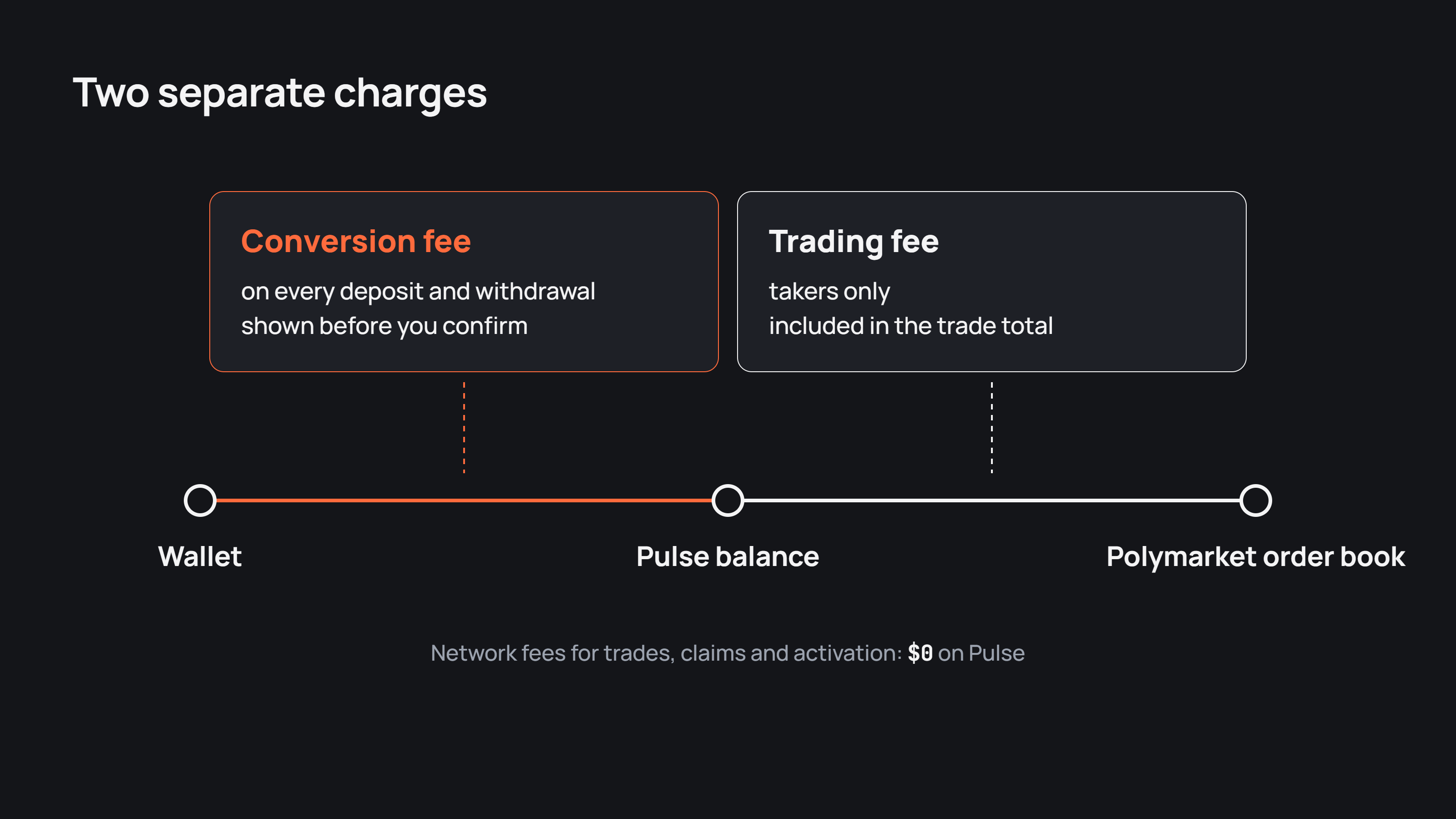
Network fees are a third item, and on Pulse you do not pay them for trades, for claiming a payout or for activating the account.
Where you see the fee on Pulse
The trade panel shows the average price, the number of shares and the total before you confirm, with the trading fee already inside the total. The number you confirm is the number you pay.
Market mode fills at once from the book, so it pays the taker fee. Limit mode, currently in beta, lets you set your price and an expiry. A limit order that rests in the book fills as a maker and pays no fee. The choice between the two is covered in market or limit order.
Your next step
Open the Pulse terminal and pick two markets in different categories, one near 50¢ and one near 90¢. Enter the same amount in the trade panel for each, without confirming, and compare the totals. The gap between them is the fee curve at work.


