Prediction Market Order Book: Depth, Spread and Slippage
Prediction market order book basics: bids and asks, why the price on screen is a midpoint, how spread and depth set your fill, and when an order slips.

An order book lists every open order to buy and sell shares in a market, with prices and sizes. The price shown on screen is the midpoint between the best buy and the best sell. What you pay depends on the book: the spread between those two orders, and how much size sits at each level behind them.
What the order book shows
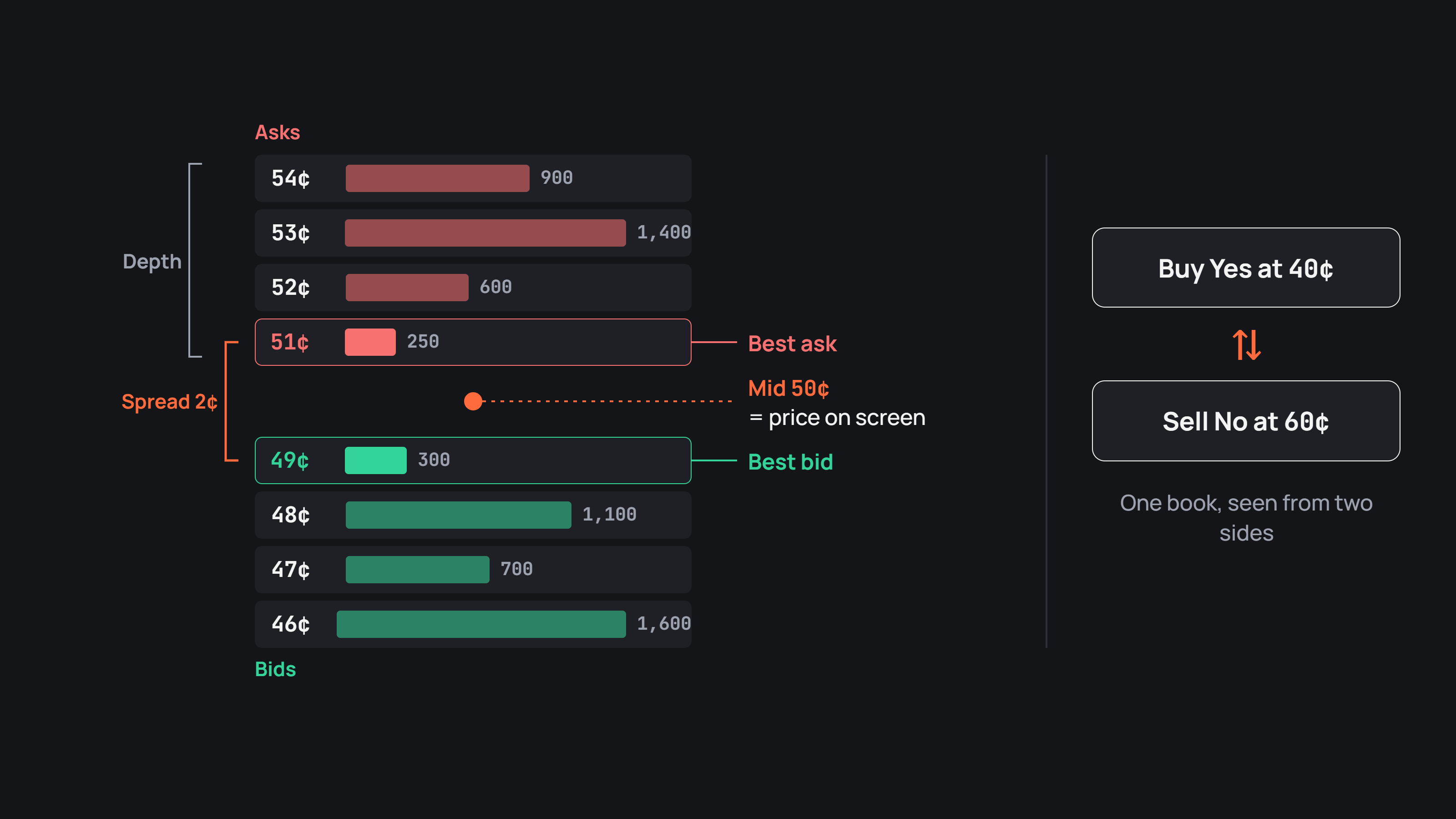
A prediction market order book has two sides. Bids are orders to buy, listed from the highest price down. Asks are orders to sell, listed from the lowest price up. Each line shows a price and the number of shares available at it.
The two sides meet in the middle. The highest bid is the best price anyone will pay right now, and the lowest ask is the best price anyone will sell at. A trade happens when a new order reaches across that gap and meets an order already waiting on the other side.
On Polymarket the book lives in the CLOB, its central order book. Orders are placed, matched and cancelled there, off the blockchain. Once two orders match, the trade settles on-chain on Polygon.
Why the price on screen is the midpoint
The price you see for a market is not the last trade. It is the midpoint between the best bid and the best ask.
If the best bid is 49¢ and the best ask is 51¢, the market shows 50¢. That number is the market's current estimate of the probability, and it is how price works as a probability. But nobody is selling at exactly 50¢. A buy order filled right now pays at least 51¢, and a sell order receives at most 49¢.
The midpoint is the right number for reading the market. The book is the right place for pricing your own trade.
Yes and No are one book
Every market has two outcomes, and their prices add up to $1. The books for Yes and No mirror each other.
A bid to buy Yes at 40¢ is the same commitment as an offer to sell No at 60¢. So when you look at the No side of a market, you are looking at the same orders as the Yes side, flipped. Liquidity is not split between two books; it is one pool seen from two directions.
Spread: the cost of getting in and out
The spread is the gap between the best bid and the best ask. It is the price of trading immediately.
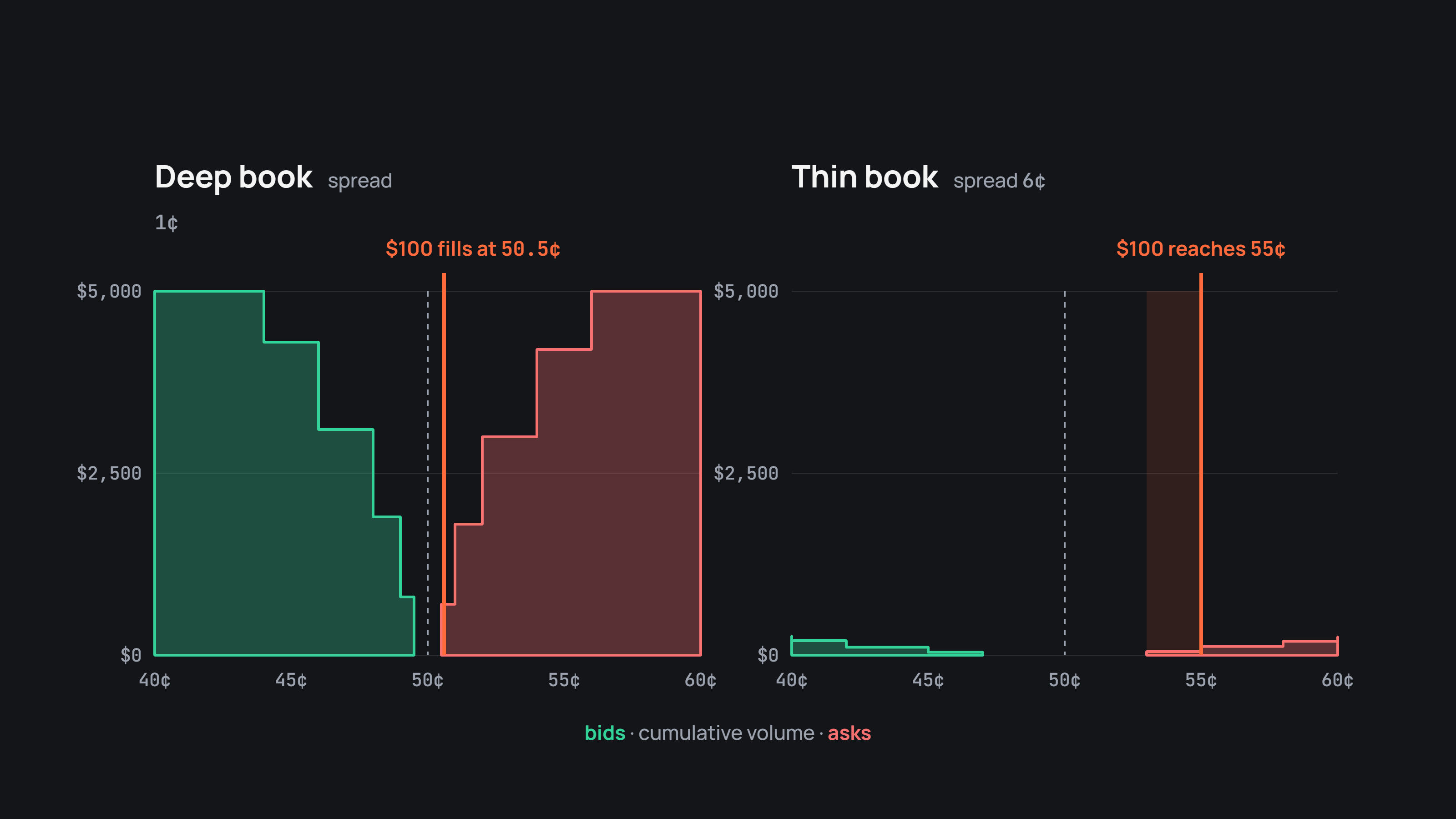
Buy at the ask and then sell straight away at the bid, and you lose the spread even if the market has not moved. That is why the spread matters most for traders who enter and exit often. In a market with a 1¢ spread the round trip costs little. In a market with a 6¢ spread the price has to move 6¢ in your favour before you are even.
Spreads tend to be tight in busy markets and wide in quiet ones. They also widen before scheduled news, when makers pull orders to avoid being caught on the wrong side.
Depth: how much size sits at each level
The spread tells you the price of the first share. Depth tells you the price of the rest.
Each level of the book holds a certain number of shares. If your order is smaller than the size at the best ask, it fills entirely at that price. If it is larger, it takes everything at the best level and moves on to the next one, at a worse price. A book with plenty of size near the top is deep. A book where the size thins out quickly is shallow.
Depth is uneven across a market's life. It is usually greatest around the most active hours and around the event itself, and thinnest in long-dated markets that few people trade day to day.
Slippage: when your order walks the book
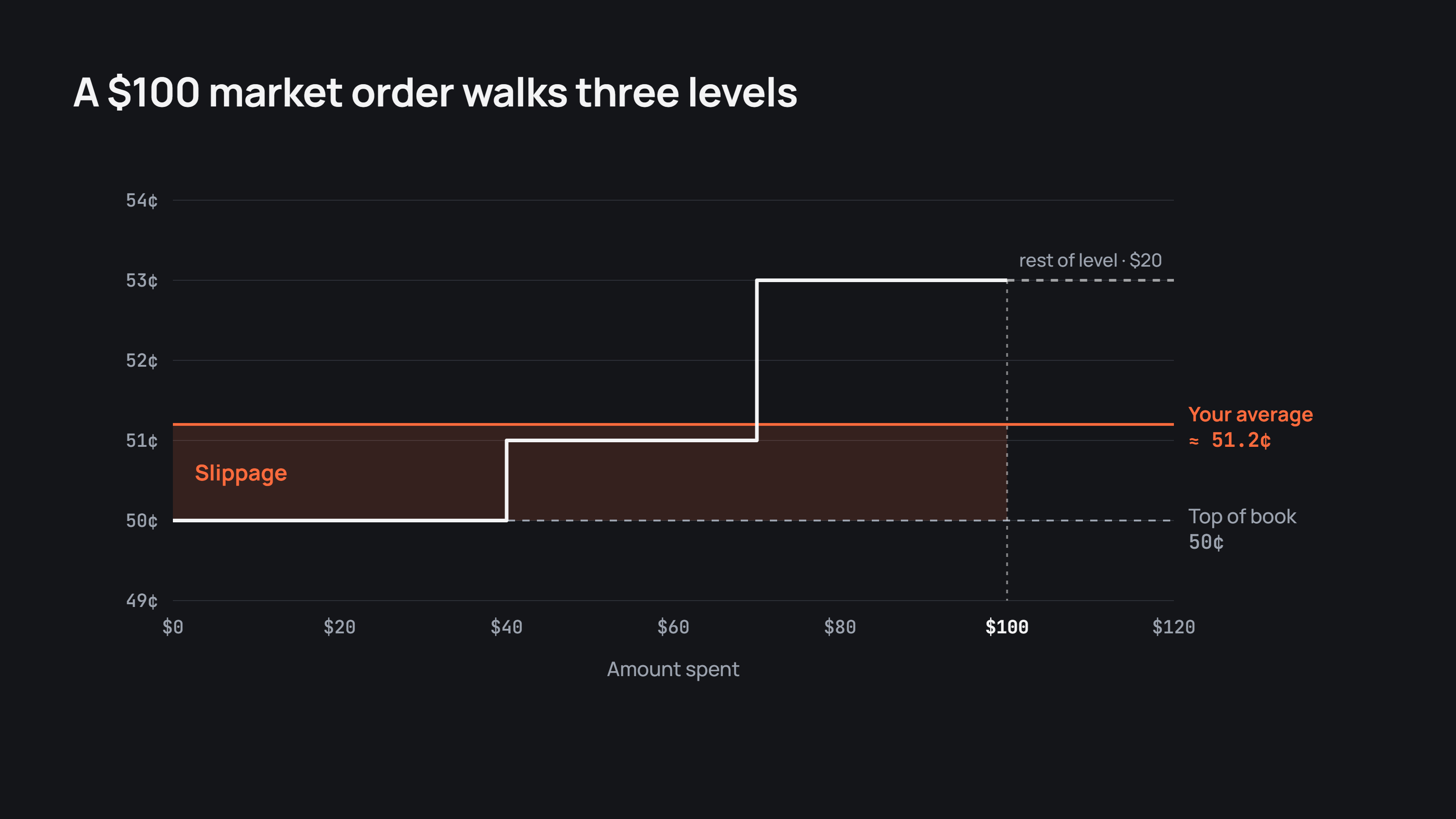
Slippage is the difference between the price at the top of the book and the average price you receive. It appears whenever an order takes liquidity from more than one level.
Take a market where the asks read: $40 of shares at 50¢, $30 at 51¢ and $50 at 53¢. A $100 market order takes all of the first two levels and $30 of the third. Across the three levels you pay an average of about 51.2¢ per share, even though the top of the book showed 50¢.
On a small order the difference is a fraction of a cent. On a large order in a shallow book it can be larger than the fee and the spread combined. Trading fees come on top of that average price.
Thin books and fast books
Two kinds of market call for extra care.
Thin books are markets with little size at each level: smaller leagues, niche political questions, markets that settle months from now. Spreads are wide and a single order can move the price. Here the average fill matters more than the midpoint.
Fast books are markets where the book changes faster than a person can read it, like short crypto sessions or matches in play. Much of the size comes from automated traders who update their orders every moment. The book you saw when you decided may not be the book that meets your order.
What else the book tells you
Beyond price and size, the shape of the book says something about the other traders in the market.
Large resting orders. A single big order at one level holds the price there until someone fills it or its owner cancels it. It shows where one trader is willing to commit, not where the market must go.
Imbalance between the sides. When the bids are much deeper than the asks, it takes less buying than selling to move the price. The imbalance can shift in a second, so it describes the moment rather than predicting the next move.
Orders that vanish. Size that appears and disappears near the top of the book, especially just before news, is usually makers managing their risk. Treat it as a reason to check the book again just before you trade.
Reading the book in the Pulse terminal
The Liquidity block under the trade panel shows the order book and the spread for the market you have open. Before you confirm, the trade panel shows the average price, the number of shares and the total, so the effect of walking the book is visible before you commit.
Market mode takes the book as it stands when you press the button and fills against the available size. Limit mode, currently in beta, lets you name your price: the order rests in the book and fills only at that price or better. Which one to choose depends on whether speed or price matters more for a given trade, and that choice is covered in market or limit order.
In the screener, the spread, liquidity and 24-hour volume columns show which markets have a deep book before you open any of them.
Your next step
Open the Pulse terminal and pick two markets: one near the top of the screener by volume and one from the bottom. Open the Liquidity block in each and write down three numbers: the best bid, the best ask and the size at the best ask. Compare how far a $100 order would reach in each book.


