Political Prediction Markets: Elections, Appointments and Wording
Political prediction markets on Polymarket: what trades, how polls move prices, and why three phrases in the rules decide who gets paid. A guide before you enter.

Political prediction markets let you trade the outcome of elections, appointments, resignations and votes. The price reflects what traders expect, but settlement follows the exact words of the market's rules, not the spirit of the news. In politics, most costly surprises come from wording: what counts as announced, which deadline applies and whose reporting is trusted.
What trades in political markets
Political markets on Polymarket fall into a few families.
Elections. Who wins a race, which party controls a chamber, the margin or turnout in a given contest. Around a large vote, one election splits into dozens of separate markets.
Appointments and departures. Whether a named person is nominated, confirmed, dismissed or resigns by a date.
Legislation and decisions. Whether a bill passes, a vote happens, or an official decision is published by a deadline.
Statements and actions. Whether a leader says, signs or announces something within a window.
The United States midterm elections on 3 November 2026 are the largest political event on the calendar this autumn. Expect many related markets, from control of each chamber to individual seats, each with its own rules and its own settlement source.
Three phrases that decide settlement
Two traders can agree on the news and still disagree on the payout, because the rules define the event more narrowly than a headline does. Three phrases do most of that work.
"announced". A market that asks whether something will be announced settles on the statement, not on the act. If a resignation is announced for next month, an "announced by" market can resolve Yes today, while a "leaves office by" market waits for the actual departure.
"By the date". A deadline includes a time and a time zone, and the rules state both. A decision published an hour after the cutoff in the stated time zone counts as late, even if it is still the same calendar day where you live.
"Credible reporting". Many markets settle on a consensus of credible reporting rather than one official document. That wording decides what happens when early reports disagree, when a single outlet runs a story first, or when an official source is silent.
One election, many markets
A large election is not one market but a family of them, and the members are linked. Control of a chamber depends on individual seats. A margin market depends on the winner market. Turnout can move several of them at once.
Linked markets do not always move together in the moment. A price in a thinly traded seat market can lag behind the chamber market by minutes or hours after news breaks. That gap is visible to anyone watching both, which is also why it rarely lasts.
Settlement can differ between members of the same family. One market may settle on media projections of a winner, another on certified results weeks later. A recount or a court challenge can leave one of them open long after the other has paid out. Before trading two related markets as a pair, check that both settle on the same source and on a similar timeline.
Read the rules before the price
Every market page carries its rules: the question, the conditions for Yes, the conditions for No, the deadline and the resolution source. Read them before you look at the price, for two reasons.
First, the rules tell you what you are buying. A market titled with a simple question can carry conditions that change it: a named official body, a minimum threshold, or an exception for recounts and appeals.
Second, a price that looks wrong often reflects wording you have not read yet. If a market trades far from what the news suggests, check the rules before assuming the crowd missed something.
How polls and news move the price
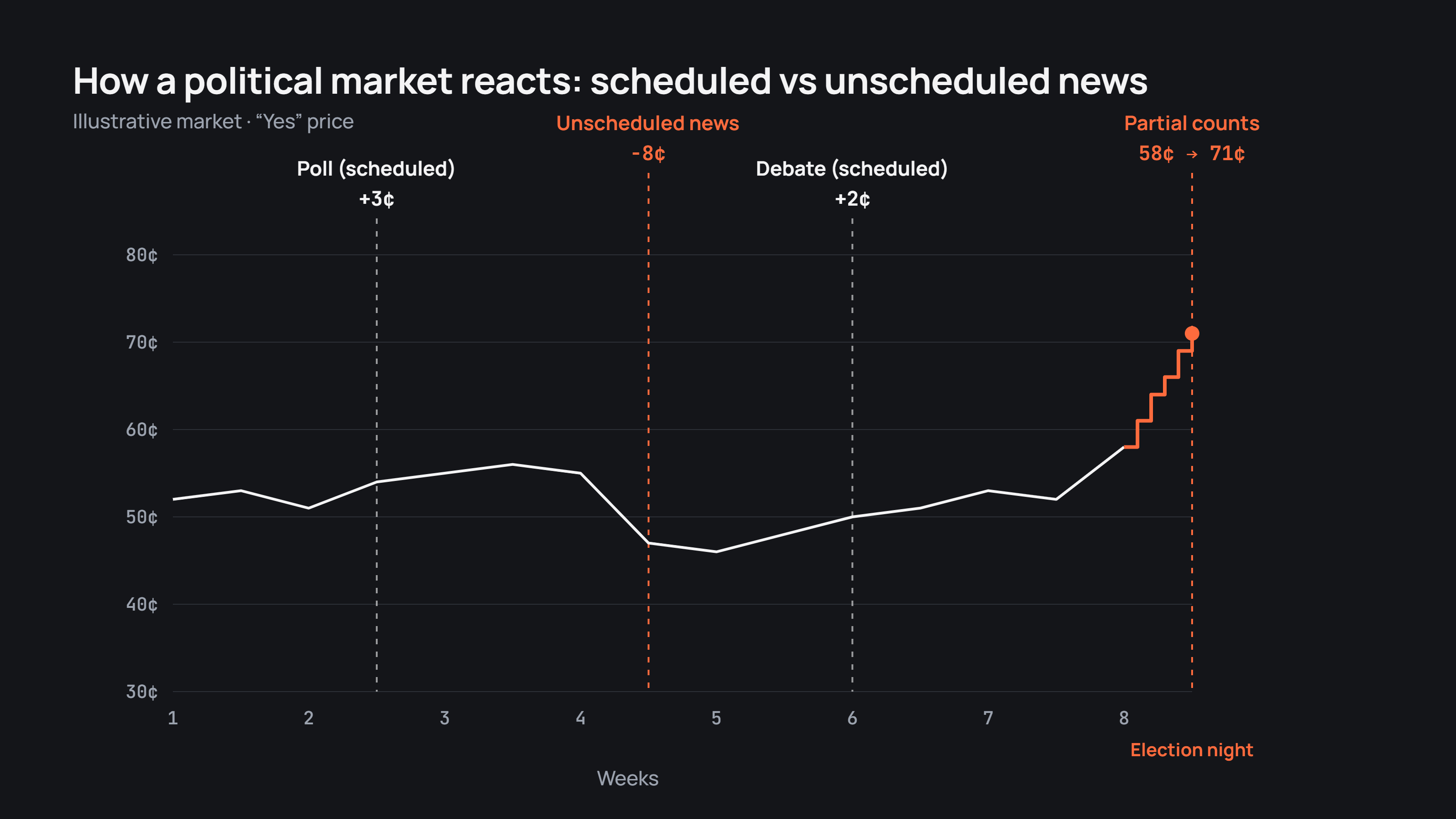
The price moves through trades, and trades follow new information. In politics that information arrives in a few recognisable forms: scheduled polls, debates, filing deadlines, official counts and unscheduled news.
Scheduled events are priced in advance. Traders position before a debate or a poll release, and the move afterwards reflects only the surprise, not the event itself. Unscheduled news moves prices faster and further, because nobody held a view on it an hour earlier.
On election night the pattern changes again. Partial counts arrive district by district, and prices can swing sharply between early and late results. Whether a market settles on projections, certified results or credible reporting of a winner decides when the swinging stops.
Long markets and the cost of time
Political markets often run for months. An appointment market can open in spring and settle in autumn. That time has a cost, because the money in the position cannot work elsewhere.
Compare two markets where your estimate beats the price by the same 10 points. One settles next month, the other in six months. Spread over time, the second earns about one sixth as much per dollar per month. The gap is the same, the return on time is not.
This is why edge differs by category: liquidity, time to settlement and who you trade against shape how much a correct view is worth. In long political markets, time to settlement often matters as much as the size of the gap.
When a political market is disputed
Political questions draw more disputes than most categories, because the wording meets messy events. Polymarket settles these markets through the UMA oracle.
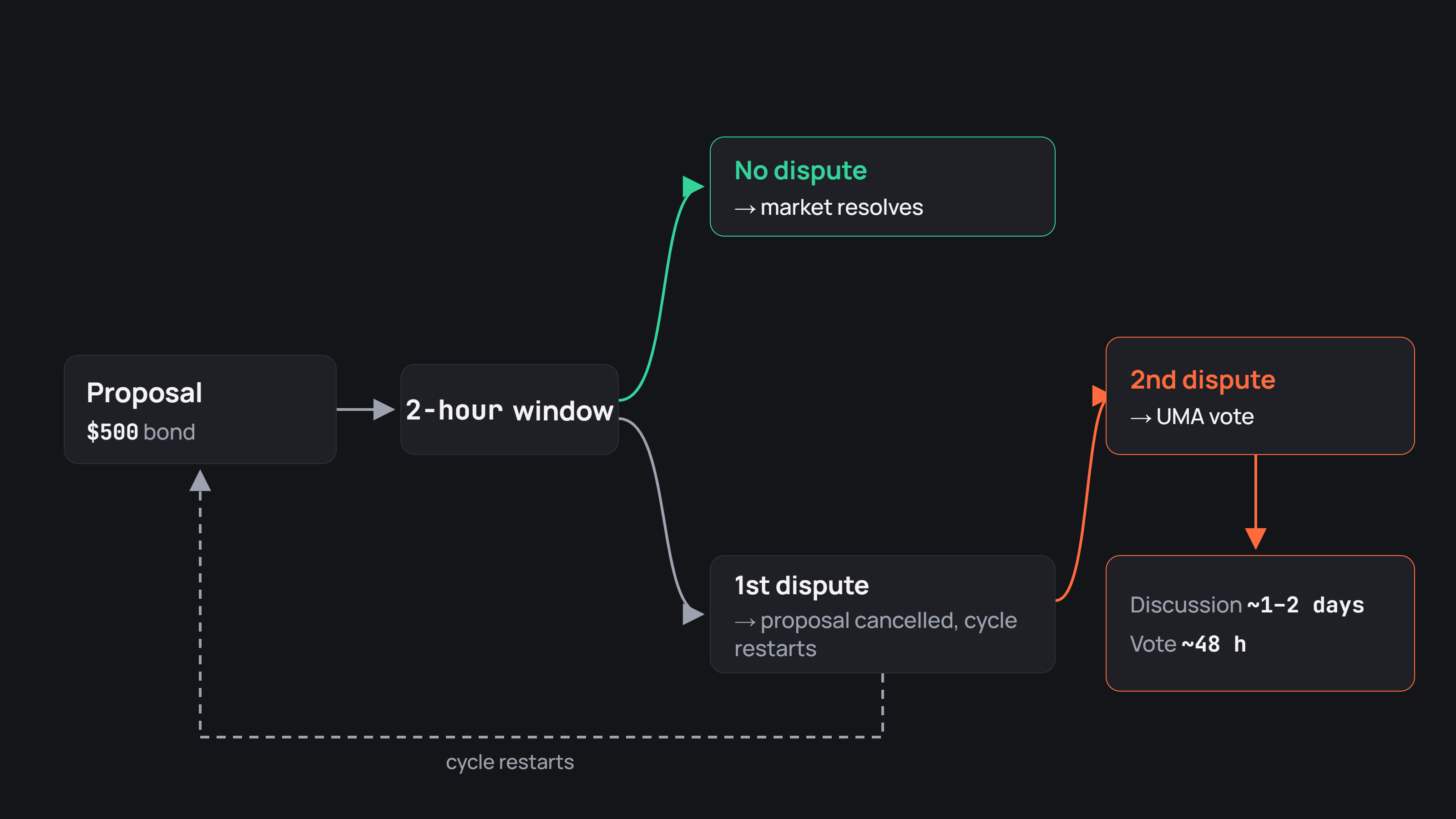
Someone proposes an outcome and posts a $500 bond. A two-hour window opens. If nobody disputes, the market settles and the proposer gets the bond back with a small reward. A first dispute does not start a vote: the proposal is cancelled and the cycle starts again. A second dispute on the same question goes to UMA's voting mechanism, where token holders decide after roughly a day or two of discussion and about 48 hours of voting.
While a market is disputed, prices can move sharply on each argument, and the final answer can take several days. The full process, with timing and what happens to the payout, is in how markets resolve.
What political markets cost
Politics carries a taker fee of $1.00 per 100 shares at 50¢, and less as the price moves toward either end. Makers pay nothing and receive 25 % of the fees back as rebates. Geopolitics is a separate category and carries no trading fee at all. Check which category a market sits in before comparing costs. The full table is in Polymarket fees.
Finding political markets on Pulse
The screener filters by the Politics topic and by time to close, from 30 minutes to a year. Two presets help most here. Undecided shows markets where both sides trade between 40¢ and 60¢, where the crowd agrees least. Top movers shows markets where the price moved by more than a tenth within the hour, which in politics usually means fresh news.
After a few settled trades, the Analytics section shows your results by category. It is the plainest way to see whether your political reads beat the price or only felt right at the time


