Polymarket Bots: What They Do and Where They Break
Trading bots on prediction markets: four jobs they do on Polymarket, where they dominate, what they cannot read and what they mean for your fills.

Bots on Polymarket are programs that place and cancel orders automatically. Most do one of four jobs: quote both sides as market makers, keep linked markets in line, react to price feeds, or copy chosen wallets. They are fast and tireless. They fail where a market depends on wording, context or a sudden change in the rules.
What a trading bot does on a prediction market
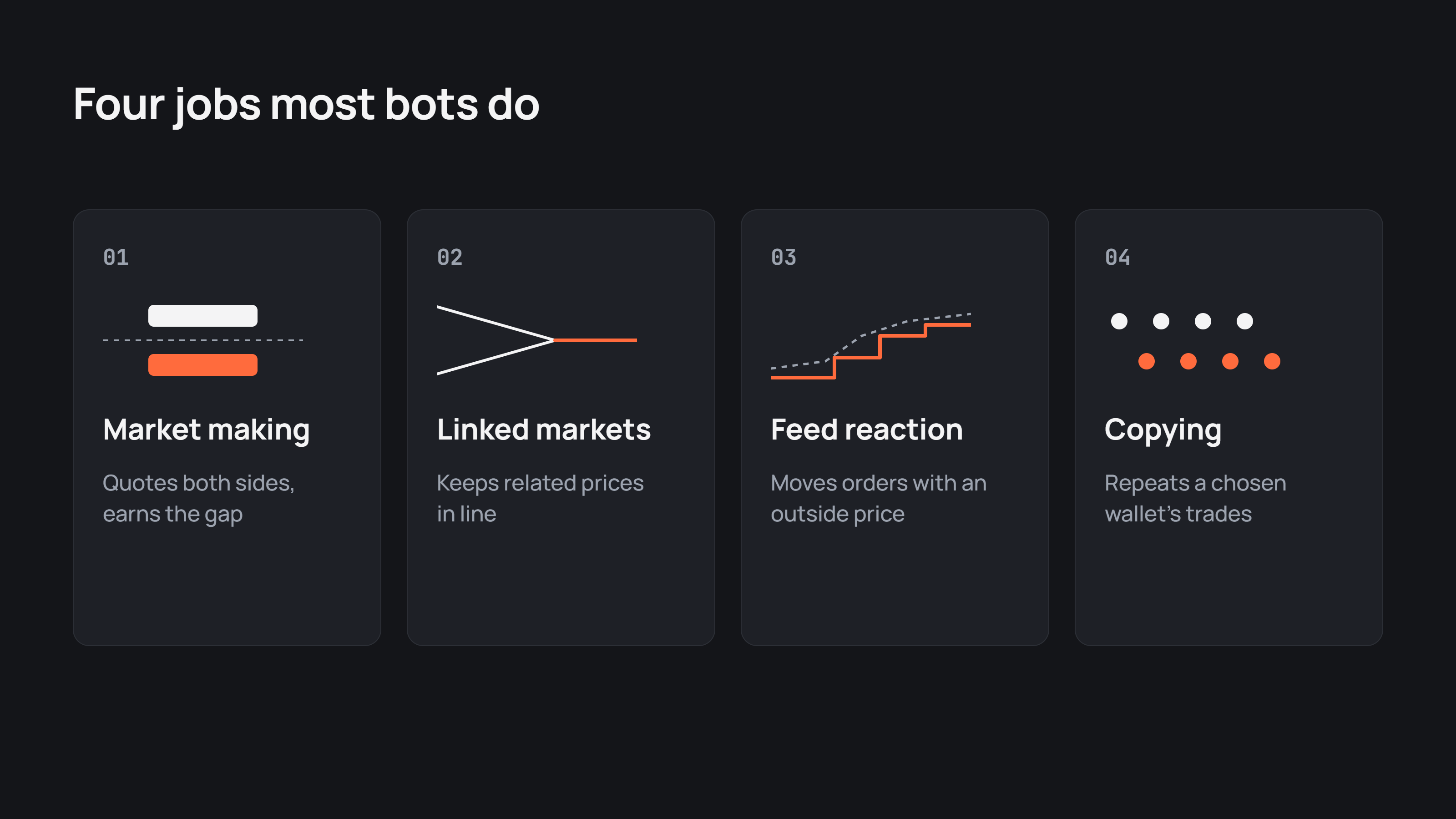
A bot connects to Polymarket's order book, the CLOB, with its own credentials. It reads the book and the stream of trades, applies a rule, and sends or cancels orders without anyone pressing a button. What differs between bots is the rule. Four jobs cover most of the activity.
Market making. The bot keeps a buy order and a sell order on both sides of the price and earns the gap between them when both fill. On Polymarket makers pay no trading fee and receive part of the takers' fees as a daily rebate. The fee design rewards this job directly.
Keeping linked markets in line. Some markets are tied to each other. The outcomes of one event should add up to $1, and a chamber market depends on individual seats. When prices drift apart, a bot trades both sides until the link holds again.
Reacting to a feed. In markets that follow an outside number, such as the price of bitcoin, the bot watches that number and moves its orders as it changes, faster than a person can.
Copying. The bot follows a chosen wallet and repeats its buys and sells, usually scaled to a smaller account.
Where bots dominate: short crypto markets
Short crypto markets are where automated trading is heaviest. These are the up-or-down contracts on bitcoin, ether and solana with five-minute, fifteen-minute and four-hour windows. Each one asks a single question about a price, over a clock measured in minutes, and a bot can answer it continuously.
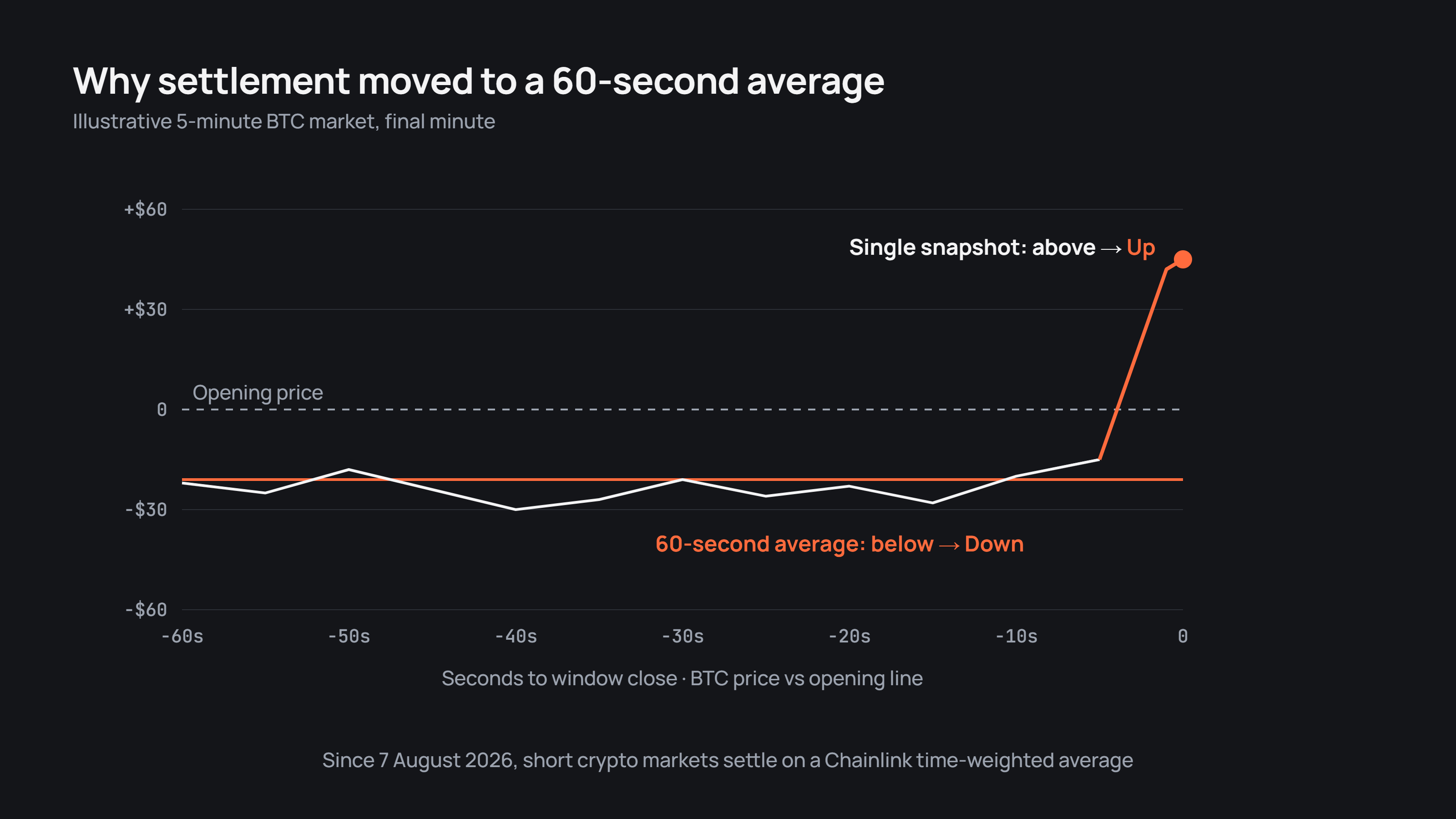
Since 7 August 2026 these markets settle differently from the rest of Polymarket. Instead of the UMA proposal and dispute process, they resolve on a time-weighted average price computed by Chainlink at the end of the window. The five- and fifteen-minute markets now use a 60-second average. Five-minute markets started with a 30-second average and moved to 60 seconds on 14 August.
The change closed a gap that a single snapshot left open. When one price at one moment decided the outcome, a large trade on a thin exchange in the last second could move the settlement price. An average over a minute makes that much harder. For traders it also means the final seconds matter less than before, while the last minute as a whole matters more.
What a bot reads
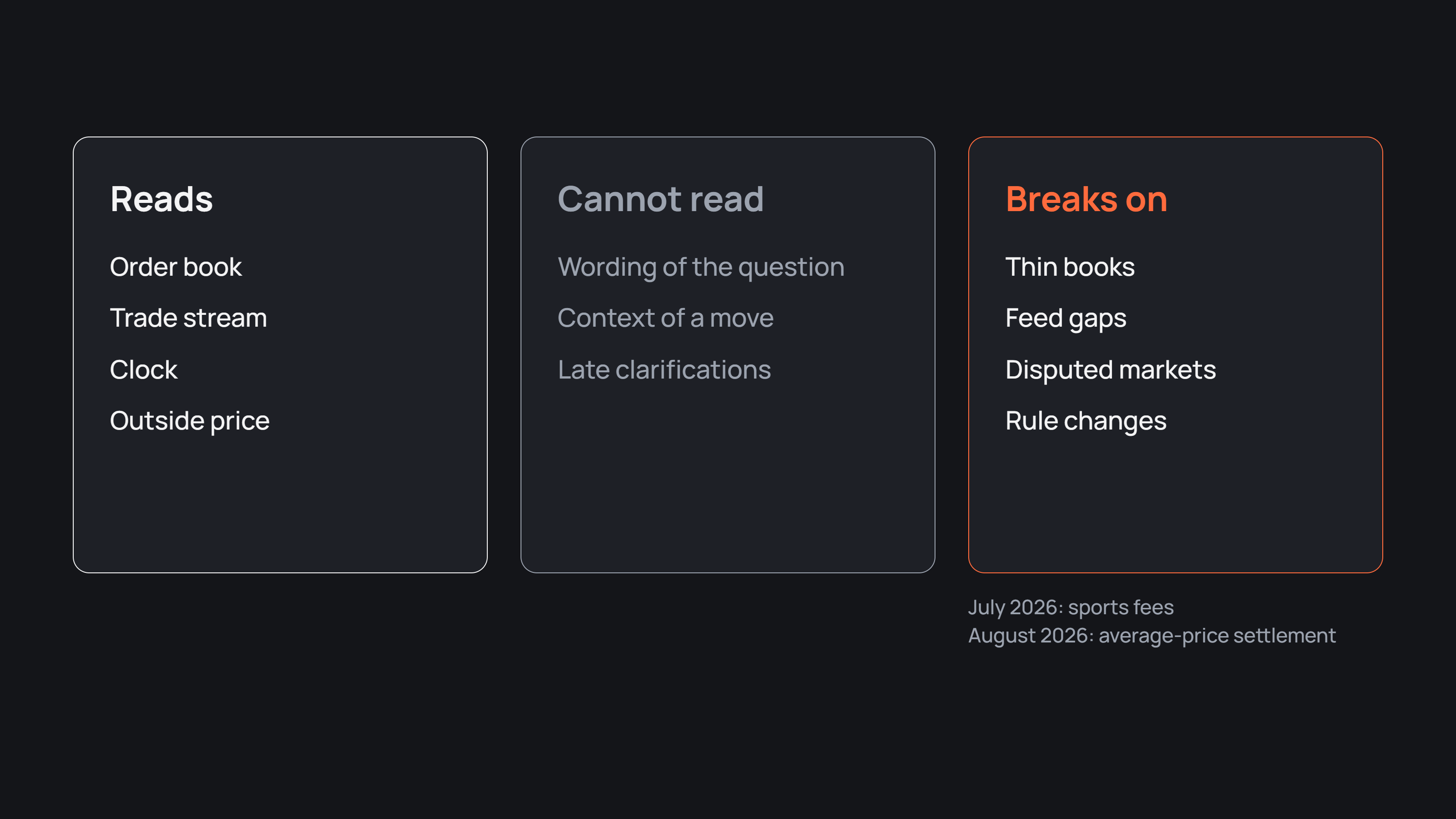
A bot works with three inputs: the order book, the trade stream and the clock. From those it knows the best prices, the size at each level, what has just traded and how long the market has left. Feed-driven bots add a fourth input, the outside price they track.
That is enough for jobs where the question is fixed and the answer is a number. A five-minute bitcoin market asks the same question every time. Quoting two sides of a busy market is the same task every minute. These are the jobs bots do well.
What a bot cannot read
The limits start where a market needs interpretation. A bot does not read the question. It cannot tell that a market is cheap because its wording makes the outcome nearly impossible. Nor can it weigh a late clarification from the market's creator. The broader point, that rules handle repetition while people handle context, is covered in terminals, bots and the exchange interface.
Context is the second blind spot. A bot sees a price move but not why it moved. For the first few seconds, a drop on a rumour and a drop on an official announcement look the same in the book.
Where bots break
Bots fail in predictable places, and those places are worth knowing because they are where prices misbehave.
Thin books. With little size at each level, a bot's own orders move the price. A rule tuned for a busy market can chase its own trades in a quiet one.
Gaps in the feed. A feed-driven bot is only as good as its data. A delayed or frozen price source leaves it quoting stale prices until someone else fills them.
Disputed markets. When a market's outcome is challenged, its price can swing on each argument while the answer is days away. A rule that treats the price as a probability has nothing to work with.
Rule changes. A fee change or a new settlement method can turn a working strategy into a losing one overnight. Sports fees rose in July 2026, and short crypto markets moved to average-price settlement in August. Each change forced automated traders to adjust.
How to tell a market is bot-heavy
You can often see automated trading in the book itself, without any special tools.
Prices that update constantly. The best bid and ask change several times while you watch, even when nothing is happening in the news.
Symmetric quotes. Orders of similar size sit at the same distance above and below the price and move together.
A spread that barely changes. In busy bot-quoted markets the spread stays at a cent or two through most of the day.
Instant reaction to an outside price. In crypto markets the book shifts within moments of a move in the underlying coin.
None of this is a warning sign on its own. It tells you the price already reflects fast information, so your edge has to come from somewhere slower.
What bot activity means for your fills
Bots shape the book you trade against, in both directions.
Market-making bots keep spreads tight and depth steady in busy markets, which makes your fills cheaper. In short crypto markets they also react to the underlying price before you do. The book you see has usually already absorbed the latest move. How depth and speed show up in the book is covered in how to read an order book.
The practical conclusion is to choose where speed decides the outcome and where judgment does. In a five-minute window, reaction time belongs to the machines. In a market that turns on how a rule is worded, it does not.
Automation in Pulse
Pulse lists three features as Coming soon: trading automation by rules you set, an AI assistant for reviewing markets and your own trades, and API trading for your own bots and tools. They are planned and will be announced when they launch.
Today the terminal covers the parts a person does best: the screener for finding markets where judgment matters, the Liquidity block for reading the book before an order, and Analytics for checking the results afterwards. What each of those tools answers is covered in prediction market tools and analytics.
Your next step
Open the Pulse terminal, set the screener to the Crypto topic with time to close at 30 minutes, and open one five-minute market. Without trading, watch its book through the final minute of the window and note how often the best prices change. Then open a long political market and compare.


