Copy Trading on Prediction Markets - How It Works
Copy trading on Polymarket: how a copy follows a wallet, why it fills later and higher, what size and fees change, and what never gets copied.

Copy trading on a prediction market means following a chosen wallet and repeating its trades automatically, usually through a bot. Because every Polymarket trade is public, any wallet can be followed. The copy never gets the same trade, though: it enters after the original, often at a worse price, at a different size, and without the reasons behind it.
How copy trading works on an on-chain market
On Polymarket every executed trade settles on the Polygon blockchain, and every trade is visible in the market's history. A copy service watches the addresses you choose. When one of them buys or sells, the service places a matching order in your account, scaled to a size you set.
Most services let you choose how to scale: a fixed amount per trade, a share of the original size, or a share of your balance. Some add filters, such as copying only certain categories or skipping trades below a minimum. What they cannot change is the order of events. The original trade happens first, and the copy reacts to it.
Reading a wallet by hand, before anything is automated, is covered in how to read other traders' wallets. Copy trading is the same reading turned into a rule.
Why the copy fills later and higher
A copy cannot see an order before it trades. It learns about a trade once the trade has happened, then needs time to build and send its own order. That gap can be short, but it is never zero, and in busy markets other bots react within it too. Where automated traders are fastest is covered in what bots do and where they break.
In that gap the market moves, often because of the original trade itself. A large buy takes the cheapest shares from the book, so the best available price is higher right after it than right before it. The copy arrives at a book that the original has already thinned out.
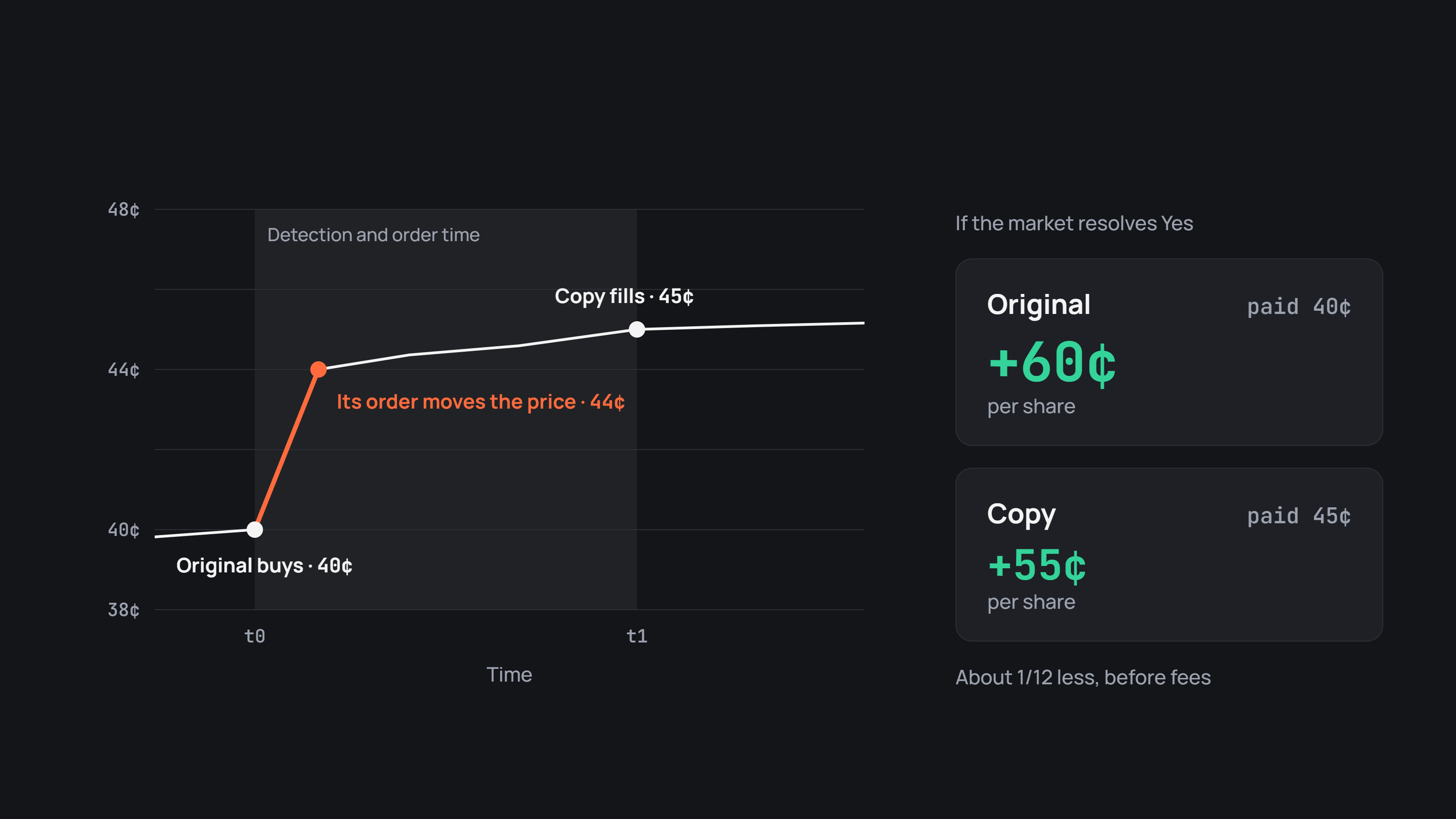
Take a wallet that buys at 40¢. Its order pushes the price to 44¢, and the copy fills at 45¢. If the market settles Yes, the original earns 60¢ per share and the copy earns 55¢, about one twelfth less before fees. If the market settles No, both lose, but the copy loses 45¢ per share instead of 40¢.
Why size changes the result
The original and the copy rarely trade the same size, and both directions cause trouble.
A copy much smaller than the original fills without moving the price, but it still pays the higher price the original left behind. A copy that is large relative to the book walks several levels and pushes its own average price up further. In a thin market, a popular wallet with many followers can find that its copiers are bidding against each other within seconds of its trade.
Scaling also breaks the original's position sizing. A trader who puts 2 % of a large balance into a long shot is making a small bet. A copier who mirrors the same dollar amount from a small balance is making a big one.
Maker and taker: when the edge flips
Some profitable wallets earn much of their result as makers. They place limit orders that rest in the book, pay no trading fee and collect part of the fees paid by takers as a daily rebate.
A copy of that wallet usually works the other way. It reacts after the original's order fills and has to trade at once, so it takes liquidity with a market order and pays the taker fee. On Polymarket that fee reaches $1.75 per 100 shares at 50¢ in crypto. A strategy that is profitable for the maker, fee-free and paid in rebates, can be unprofitable for a copier paying fees on every entry and exit.
You copy the entry, not the reason and not the exit
A trade in the history shows what a wallet did. It does not show why.
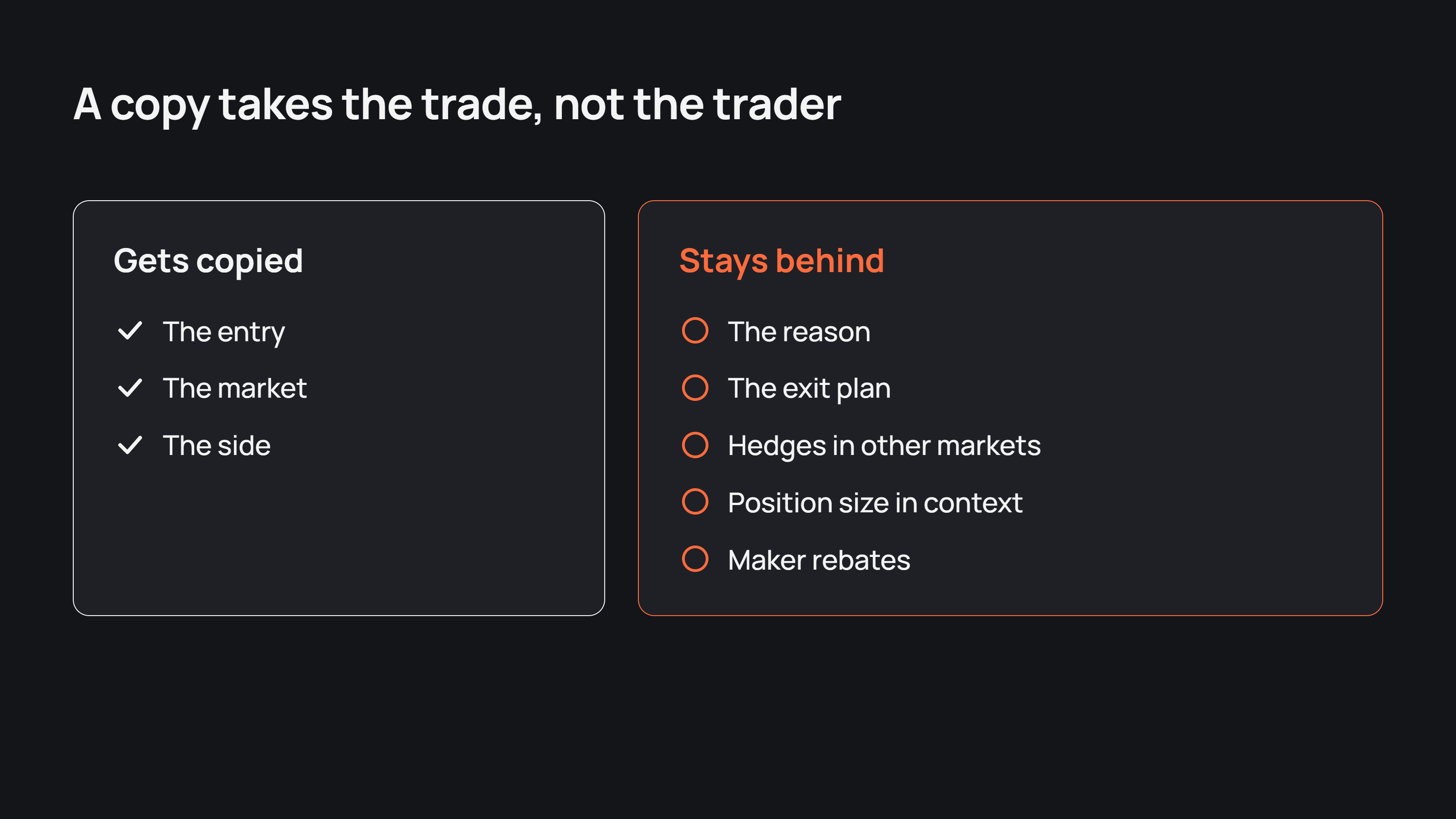
The reason. A buy can be a new view, a hedge against a position in a related market, or the closing leg of a trade opened elsewhere. The copy treats all three as the same signal.
The exit. Many traders leave positions gradually, sell part before an event, or hold until settlement depending on how the market moves. A copy service that mirrors buys well can still handle exits badly, and a copier who stops following halfway through is left holding positions without the plan that came with them.
The rest of the portfolio. A wallet's risk sits across all its positions. Copying one market takes a piece of that risk out of context.
Survivorship: the wallets you see are the ones that won
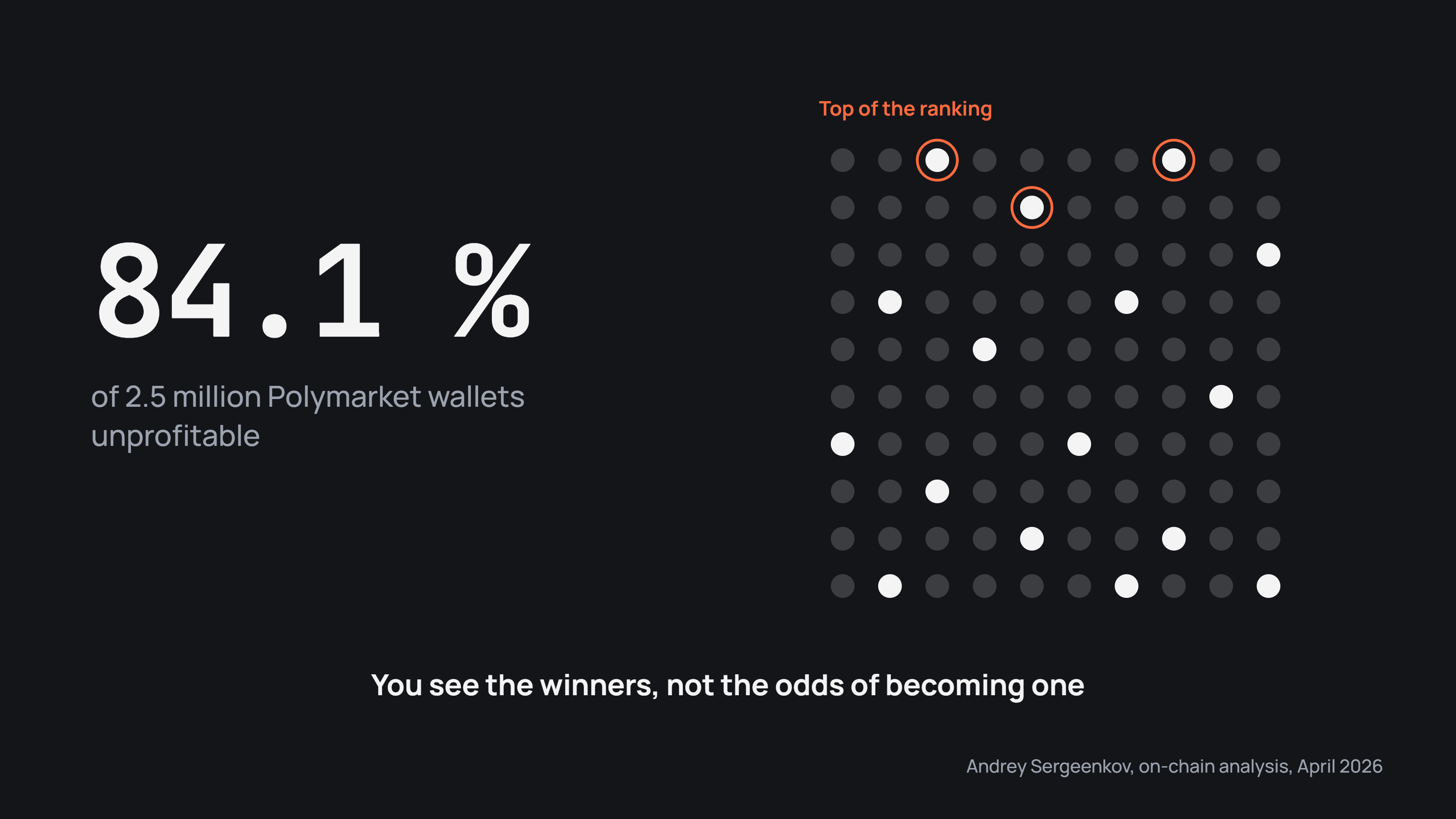
Copy trading starts with a list of wallets worth following, and that list is built from past winners. That is where the numbers work against the copier.
An on-chain analysis of 2.5 million Polymarket wallets, published by researcher Andrey Sergeenkov in April 2026, found 84.1 % of them unprofitable. Among millions of addresses some will show strong records by chance alone, and rankings put exactly those at the top. A long winning run is easier to see than to explain, and part of it is often luck that will not repeat.
Wallets also change. A trader who did well in one category can move to another, change size or stop trading, and the copy follows the change without knowing the record no longer applies.
Where copying helps
Copy trading is not useless, it is just a different tool from what it is usually sold as. Following a few wallets shows you which markets experienced traders pay attention to, how they size positions and how they react to news. As a way to find markets and ideas, it saves time.
It works best as a source of candidates rather than a stream of orders. A copied trade that you check against the rules of the market, the book and your own estimate becomes your trade. A copied trade you never looked at stays someone else's.
Questions to ask before following a wallet
How many settled trades is the record built on? A few dozen say little. Hundreds start to mean something.
Where does the profit come from? A handful of large wins, or a steady edge across many markets.
Does the wallet trade as a maker or a taker? If it earns rebates by resting orders, a copy that takes liquidity will not see the same result.
How liquid are the markets it trades? In thin books the copy pays the most for arriving late.
Who holds the keys? Some copy bots ask for your private key. Which question to ask about keys is covered in terminals, bots and the exchange interface.
Checking your own copied results
Whatever tool you use, the test is the same as for your own trades: compare entry prices with how often the positions won, over enough settled markets to mean something. Pulse Analytics does this in the Price vs. win block, and it applies to every trade in your account, whoever had the idea first. What that block and the rest of the analytics answer is covered in prediction market tools and analytics.
Your next step
Pick one wallet you would consider following and open its trade history. For its last ten buys, note the price it paid and the market price a minute later. Then open the same markets in the Pulse terminal and check the spread in the Liquidity block. The gap between the two prices, plus the spread, is roughly what a copy would have paid on top.


