Sports Prediction Markets: What Trades and How the Line Moves
Sports prediction markets on Polymarket: match results, handicaps, totals and season winners, how prices move before and during a match, and what sport costs.

Sports prediction markets let you buy shares in the outcome of a match or a season: who wins, by how much, how many points are scored. Traders set the price rather than a bookmaker. It moves with team news and with the match itself, and you can sell your position before the final whistle.
What trades in sports markets
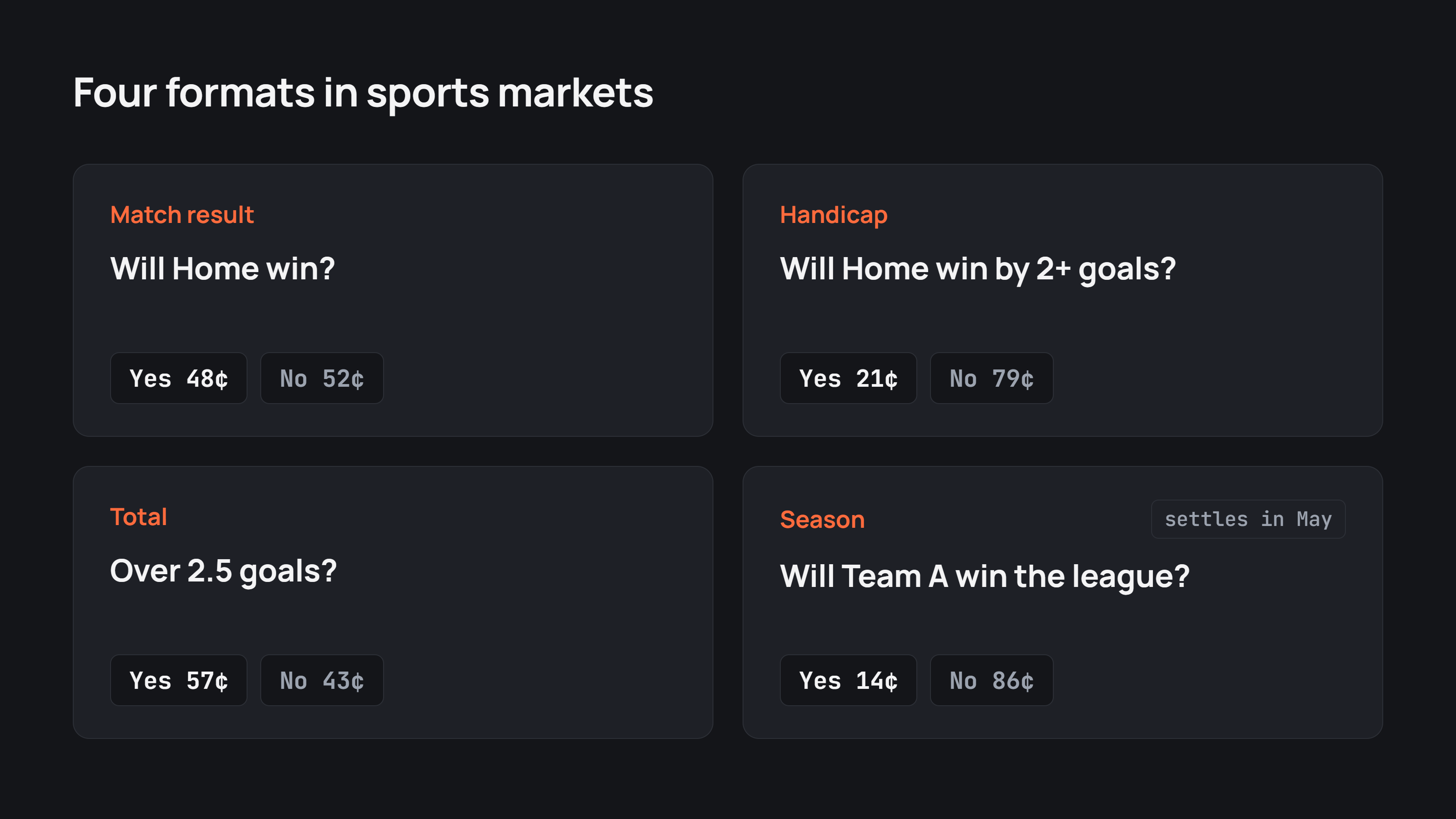
Sport on Polymarket covers several formats, and the terminal groups them by league and competition.
Match result. Who wins a given game. Some markets ask about one team, others list each possible outcome, including a draw, as a separate market with its own price.
Handicaps. Whether a team wins by more than a set margin, or loses by less than it.
Totals. Whether the combined score goes over or under a set line.
Season and tournament markets. Who wins the league, the cup or an individual award. These run for weeks or months and settle at the end of the competition.
Right now the calendar is full. American football and the European football leagues are in full swing, and the basketball season starts in late October. The number of open sports markets grows through the autumn.
How a sports market is worded
Every sports market carries its rules: the event, the condition for Yes, the deadline and the source used to settle it. Two details deserve a look before you trade.
The first is what counts as the result. A rule can refer to the score at the end of regular time or to the final result including extra time or overtime. Handicap and total markets depend on this directly, because a few extra minutes can move the score across the line.
The second is what happens if the game does not go ahead as planned. Postponements, abandoned matches and venue changes are covered in the rules of each market, and the treatment differs between markets. Read that line rather than assuming it.
What moves the price before kick-off
Before a match, the price moves on information that changes the balance between the teams. Team news and injuries come first. Then come confirmed lineups, which in football usually appear about an hour before kick-off. Weather matters in outdoor sports, while travel and a crowded schedule matter over a long season.
Large orders move the price too. A single big buyer can push a thin market several cents in one direction, and the price then settles as other traders respond. In busy markets for major leagues this happens quickly. In smaller leagues the order book is thinner and a move can linger.
In-play: how the price moves during a match
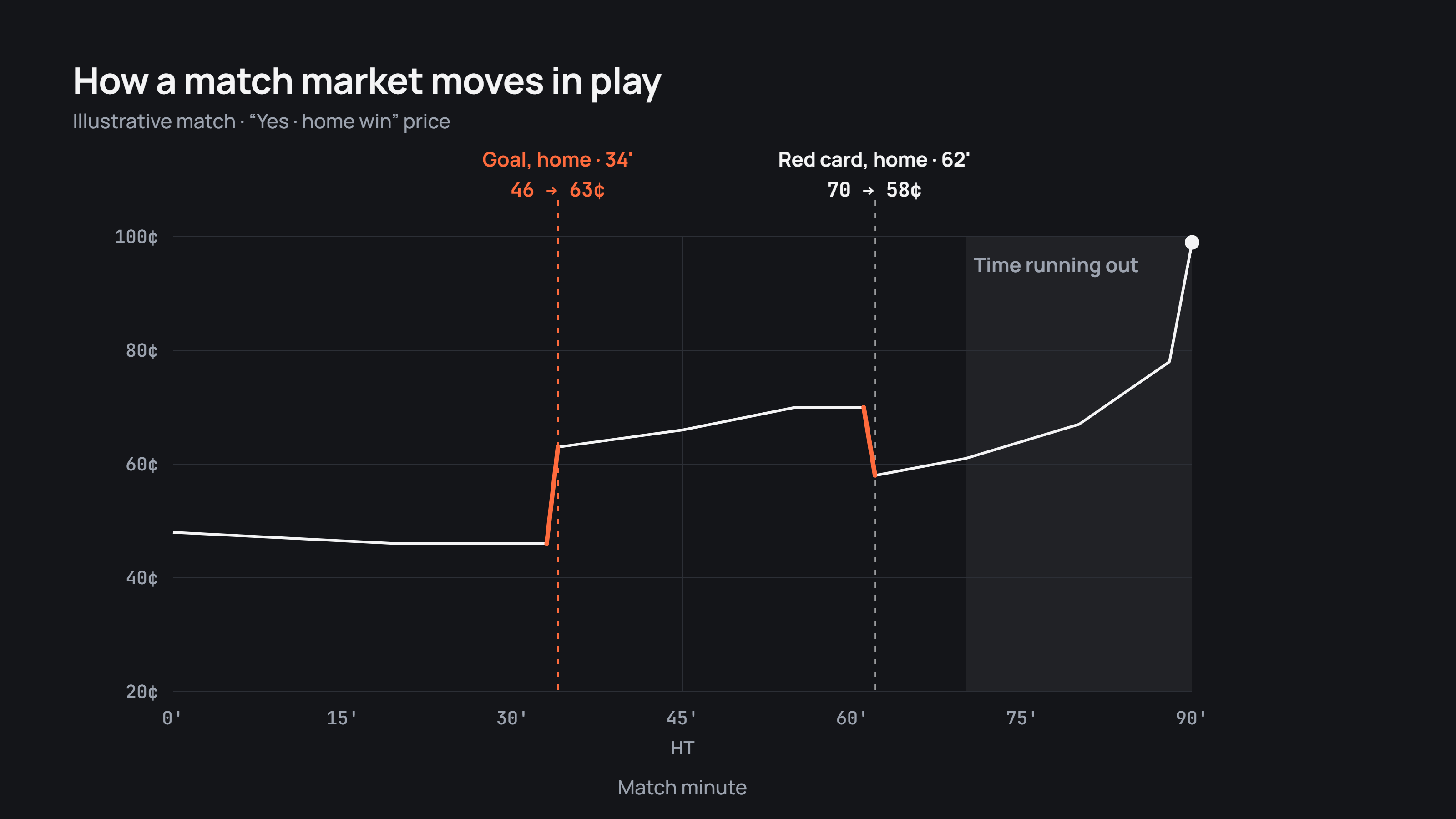
Once the match starts, the price follows the game. A goal, a red card or an injury to a key player can reprice a market within seconds. Between those moments the price drifts as time runs out. A lead is worth more with ten minutes left than with eighty.
The screener's Live now preset collects matches that started in the last eight hours and have not finished. On the event page, live matches carry a LIVE mark and the current score.
Speed matters here, and not in the trader's favour by default. A television or streaming picture often runs seconds behind the stadium. Automated traders, meanwhile, react to data feeds as events happen. By the time a goal appears on your screen, the price has usually moved. In-play trading works better as a response to how the game is developing than as a race to the next event.
Selling before the final whistle
A position in a sports market is not locked until the end. While the market trades, you can sell your shares at the current price, in full or in part.
That changes how a sports trade can be managed. You can take a gain after an early goal instead of waiting through the second half. You can also reduce a position when the match turns against you. Selling early has a cost of its own: you cross the spread and, with a market order, pay the taker fee a second time.
What sport costs
Sport carries a taker fee with a rate of 0.05, which works out to $1.25 per 100 shares at 50¢ and less as the price moves toward either end. For 100 shares at 60¢ the taker pays 100 × 0.05 × 0.6 × 0.4, which is $1.20. A limit order that rests in the book and is filled later is a maker order and pays nothing.
Makers in sport also receive 15 % of the fees collected in each market as a daily rebate. That is the lowest share on the platform, where most categories return 25 %. Both numbers changed in July 2026: the rate rose from 0.03 and the rebate fell from 25 %. The full table for every category is in Polymarket fees.
Short matches and long seasons
Sports markets sit at both ends of the time scale. A match settles within hours, while a season market can tie up money for months.
That difference shapes where an edge is worth having. A small gap between your estimate and the price can be worth more in a market that settles tonight. A larger gap in a market that settles next summer ties the money up for months. How liquidity, time to settlement and the mix of traders differ across categories is covered in where the edge is by category.
If you follow crypto markets as well, the two categories behave in opposite ways. Short crypto sessions move with a price feed, while a match moves with events on the pitch. The structure of crypto markets is covered in crypto markets on Polymarket.
Four checks before a sports trade
The result definition. Regular time or the final result including extra time.
The treatment of a postponed or abandoned game. It is in the rules of each market.
The book. The spread and the size resting at the nearest levels, which set your average price.
The exit plan. Whether you hold to the final whistle or sell at a price you choose in advance.
Finding sports markets in the terminal
The screener filters by the Sports topic and by time to close, from 30 minutes to a year. Live now shows matches in progress. Closing soon collects markets settling within 24 hours, which on a match day means tonight's games. The spread, liquidity and 24-hour volume columns show before you open a market whether your order will fit in the book.
After a few settled trades, the Analytics section shows your results by category. Time held, split between winners and losers, is worth a look in sport: it shows whether you sit in losing positions until the final whistle and close winners early.
Your next step
Open the Pulse terminal, set the screener to Sports and Live now, and pick one match in progress. Without trading, write down the price at a moment you choose, then note it again after the next goal or at half-time. The gap between the two numbers shows how fast the market reprices the game you are watching.


